Why Halloween and I aren’t so keen on each other

Halloween, 31st October 2012

I’m not opposed to giant pumpkins. I don’t have a problem with people dressing up in costume, as long as I’m not expected to don a witch’s costume to go with my chin (I was once told by a six-year-old patient that my chin is “long and pointy like a witch”, and I’ve had a chin complex ever since).

I just object to being dragged into yet other Americanised opportunity to promote childhood obesity and tooth decay.

Mind you, Halloween doesn’t seem keen on me either. This 31 October, I was travelling to Melbourne, via Sydney, heading for the RACGP to workshop the new vocational training standards. The meeting was a treat but I was tricked en route. I arrived at Sydney airport. My wallet didn’t.

I’d had it at Ballina airport when I paid for parking, but somehow I found myself in Sydney with no ID, cash or credit cards. Thanks to a kind friend who made a mercy dash to the airport with some cash, I made it to Melbourne with at least the means of getting to my accommodation.

Alas, the hotel clerk was not accommodating. Having missed my connecting flight in Sydney, I ended up arriving after midnight, and was in no mood to be told that they couldn’t give me my prepaid room without a credit card imprint and ID.

“I know my credit card details; can’t I just give you the numbers?”

“No. I have no way of verifying who you are.”

“But you take credit card bookings over the phone.”

“Yes, but that’s different.”

“How?”

“It’s over the phone.”

“Well, how about I go outside and call you on my mobile?”

“We will accept a $500 cash bond in lieu of a card, but we still need ID to give you the room.”

“I don’t have $500 or ID.”

“Then I’m sorry, I can’t help you. My hands are tied.”

I was ready to tie him up myself and steal a room key but sanity prevailed. The duty manager was called, and I eventually got a bed on which to rest my weary head.

I have a new appreciation of some of the many challenges faced by the homeless, dispossessed and utterly disorganised. For me, thankfully, it was just a blip — Halloween deja vu.

This wasn’t the first time I’d spent Halloween trying to prove my identity. In 2010, I landed at Los Angeles airport with a stolen passport, according to US Customs. I was ignominiously thrust into detention with an assortment of would-be immigrants while they “processed my case”, and released seven hours later with a curt “You can go now. Administrative error”.

Again, a missed connecting flight, which meant arriving late in Las Vegas, and an after-midnight hotel fight. They’d given away my prepaid room and claimed the hotel was full. Being Halloween in Vegas, I almost believed them, but wandering the streets at 2am with inebriated, costumed revellers didn’t seem like a good option, so I stood my ground.

They eventually found me a “special” room, which came with a full-mirrored ceiling, an enormous “love tub” set into the carpeted floor, and a bed with various attachments. I tried to convince myself it was a Vegas-style birthing suite that had been properly cleaned after last use, but the stains and lingering odours suggested otherwise. I mightn’t have minded so much if it’d come with a pool table and naked prince.

Next year I’ll try to get back into Halloween’s good books by staying at home and treating any callers to tooth-rotting ‘candy’, with my wallet and passport safely tucked away.

………………………

First published in Australian Doctor on 21st November, 2012: On Halloween

http://www.australiandoctor.com.au/opinions/the-last-word/the-last-word-on-halloween

Gloat-worthy Geography (Geo-bragging)

I’ve just read an amusing column penned by my favourite medical writer, Dr Justin Coleman, in which he mused about life as seen while luxuriating on a beach at Byron Bay.

http://drjustincoleman.com/2013/10/29/397/

(I know we’re not supposed to play favourites, but let’s be honest, we all do, whether they be friends, colleagues or patients. But you have to maintain plausible deniability when it comes to your offspring.)

Justin’s column got me a-thinking about using places as status symbols / envy-elicitors.

I’ve spent most of my life living in places where other people holiday. I was born and bred on the Gold Coast, moved to Noosa as a GP registrar and have lived in the Byron Bay region for the past 22 months.  If ever challenged, I would hastily defend my choice as being all about lifestyle and not a jot about status, but would also have to admit that I do like to geo-brag now and then, and achieve this by using gloat-worthy geographical descriptions.

Living at Pomona0020

Take my home in “Noosa” for example. Technically, I did live in the Noosa Shire for ten years (although the shire has been since been amalgamated) but the little country town in which I resided for much of that time, Pomona, was forty five minutes and a world away from the luxury and prestige of Noosa Heads.  While its location could be accurately described as a small inland town 37km north of Nambour (Clive Palmer’s new heartland) and 37km south of Gympie (where Clive Palmer is thought to be far too left-wing), describing it instead as “an idyllic town in the Noosa Hinterland” conjures up a more enviable picture.

Likewise, my current home: Ballina.  “Just south of Byron Bay” (31km) sounds more enticing than “east of Lismore”.

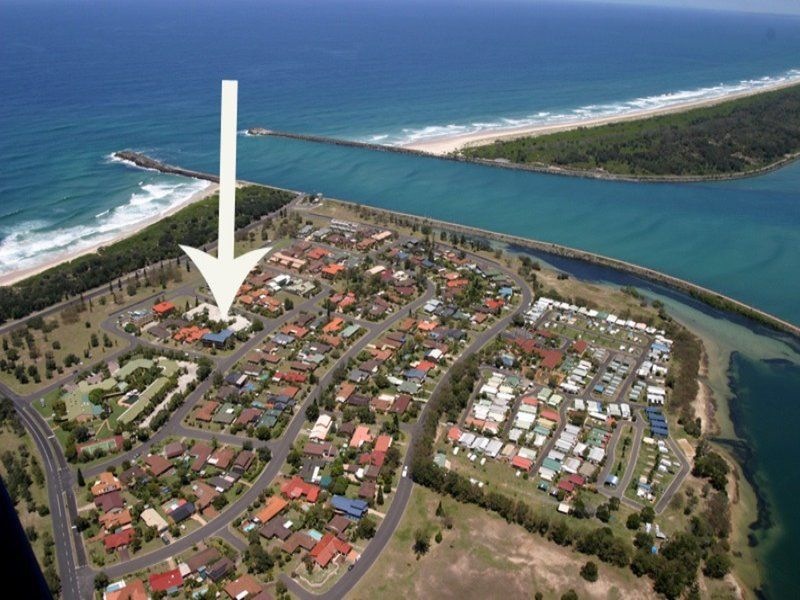
My current residence - not hard to gloat about this location

My current residence – not hard to gloat about this location

 Mind you, as soon as I mention that I live only a couple of hundred metres from a picturesque beach, and not much further from the magnificent Shaw’s Bay and the mouth of the gorgeous Richmond River, I don’t have to do much selling!


Justin also made an interesting point about the girth of the typical Byron beach goer, or rather conspicuous lack thereof.  The North Coast of NSW (as defined by Medicare Local boundaries) came in the top 10 “slimmest” regions in recently released figures, and the area around Bryon Bay (which includes hinterland towns such as Mullumbimby, Nimbin and Bangalow) would have no doubt helped to decrease the North Coast’s collective average BMI considerably.  Mind you, it also helped to decrease the region’s childhood immunisation rates. We came in the top 10 for the slimmest (aka lowest) childhood immunisation rates (by Medicare Local region) too.

Interestingly, several of the Medicare Local catchments in the bottom 10 for childhood immunisation rates, were also in the bottom 10 for obesity rates, including Eastern Sydney and the Sunshine Coast.  Probably not a chicken and egg conundrum, more a likelihood that conscientious objectors to immunisation have similar conscientious objections to eating egg McMuffins for breakfast and KFC for lunch.

My local "near-Byron" beach.

My local “near-Byron” beach.

Time for me to go for a stroll on my near-Byron beach before I prepare my chicken-and-egg-free Byron-style dinner.

To finish, I will just point out that I’m not the only one to use Byron’s name in vain. Even Ballina airport calls itself Ballina-Byron, proclaiming itself as “the gateway to beautiful Byron Bay”.  But be warned, there is a long, albeit scenic, driveway.  The taxi fare from the “gateway” to your hotel in Byron may cost you more than your airfare from Sydney!

Reflections on GP the Musical’s trip to Darwin (for GP13)

The 8th performance of GP the Musical – the show written, directed and acted by GPs – was up in Darwin this month, as part of the GP13 conference.

Cast pre-show photo Darwin 17th October 2013

Cast pre-show photo Darwin 17th October 2013

Still buzzing from our unexpectedly sold out season at the Melbourne International Comedy Festival in April, the cast members were all eager to don their costumes and dance up a storm, despite the Darwin heat.  While high on enthusiasm, we were a little rustier than anticipated and had only a very limited time to rehearse. No doubt this was quite stressful for director Dr Katrina Anderson, but she soon whipped us into some semblance of shape using her indomitable directing skills.

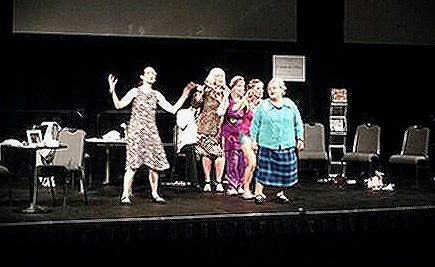
Receptionist song at GPTM Darwin

Receptionist song at GPTM Darwin

It is both daunting and comforting to perform in front of colleagues. We expected a very supportive and forgiving crowd (and they were!) but knowing there were some serious heavyweights in the crowd (the likes of RACGP president, Dr Liz Marles, Chair of Council, Dr Eleanor Chew and the legendary Professor John Murtagh) did produce a few butterflies. We weren’t sure whether these VIPs would appreciate us sending up everything from E-health records to naturopathy to heartsink patients, but our college memberships were not rescinded the next day, so they must have taken the show in the tongue-in-cheek manner intended.

Professor John Murtagh was particularly effusive with his praise of the show. He told us how he had tried to get tickets when GP the Musical was at the Comedy Festival, but was turned away by the box office due to the show being sold out.  I’m sure he was too humble and polite to do the whole “Do you have any idea who I am?” routine, but we kind of wish he had!

WONCA president Professor Michael Kidd gave us a personal apology for not being able to attend the Darwin performance (he was flying out to India that evening).  He had seen the show in Melbourne but said he had wanted to see it “one more time”.

Enough of the name dropping!

We had many non-India-bound audience members who had chosen to “come back again” for a second or third viewing.  Those who had last seen it at the 2012 GPET Convention, experienced not only a more practised performance but 20 minutes of extra dialogue and two new songs (E-health records and Naturopath Song).

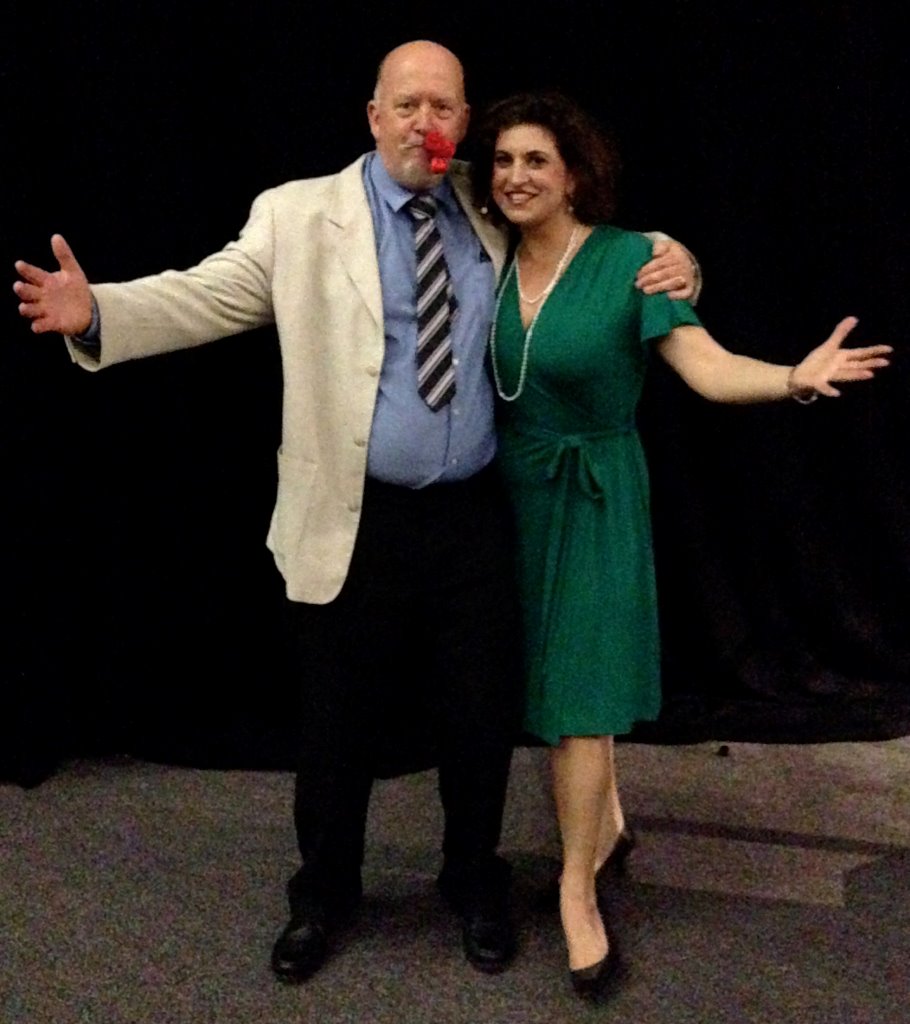
Mr Black and Dr Karla

Mr Black and Dr Karla

There were some changes since the Melbourne International Comedy Festival season too.  There were dialogue tweaks (deliberate ones, mostly ;-)) and a cast re-shuffling:  a previous patient became the female doctor and the doctor accepted a job promotion to become the receptionist.    Dr John Buckley returned as the unstoppable Mr Goodall.

The other change was that the show jumped on the social media bandwagon and had a live twitter stream:  #GPTM.  Photos and comments were posted during the show by both audience members and the show’s multi-tasking receptionist character (while on stage).  OK, I’ll stop hiding behind the 3rd person.  The crazy receptionist was me.   I’d obviously overlooked the fact that playing a new role for the first time with very little rehearsal would probably need my full attention.  At some point, I must have subconsciously  decided that acting, singing, dancing and playing live music in front of a large audience of colleagues, invited guests and VIPs was not enough of a challenge, and so added live tweeting into the mix.  Miraculously I managed to post numerous tweets using the prop conveniently placed on the desk at which I was sitting for much of the show (aka laptop) without missing cues or lines.   More good luck than good management, in retrospect. You can check out the tweets at #GPTM if you’re curious.

All in all, it was a tremendously enjoyable night (for the cast at least).

Encore performance at Rural Faculty Function

Encore performance at Rural Faculty Function

Wanting a little more of the  Darwin limelight, we came back “one more time” and did an encore performance of our final song, The one to see is your GP, the following evening at the RACGP Rural Faculty Function.  It wasn’t scheduled and we weren’t invited as such – we snuck onto stage while the star act of the evening, the very talented and entertaining GP band, the Medical Cheekydocs, took a five minute loo break.

We have the band to thank not only for a wonderful night’s music and for graciously allowing us to monopolise the stage for a few minutes, but for the existence of the musical at all.  For it was back in 2010, while the band (then called Simon and the GPETtes) were rehearsing on a station outside Alice Springs for the 2010 GPET Convention, that the idea of GP the Musical was first dreamed up by Gerard Ingham and myself (both then band members). We started writing the show a couple of months later, and the rest, as they say, is history.

We couldn’t have done any of it without our director and fabulous cast, so thank you all!

There are no future GP the Musical  shows scheduled at present, but who knows?  We may just “come back again” next year to a theatre near you.

Post show drinks

Post show drinks

Mr Goodall getting cuddly with Mr Black

Mr Goodall getting cuddly with Mr Black

I love being mistaken for a medical student

“Are you learning a lot today, dear? Are you going to be a GP too one day?”

My face breaks into a smile for a number of reasons. I love it when, as a medical educator, I’m mistaken for a student while conducting external clinical teacher (ECT) visits.

First, if patients mix up which one of us is the registrar and which is the teacher, it usually indicates they trust and respect the doctor they’re consulting.

Second, it can help put a nervous registrar at ease. We have a chat and a laugh about it afterwards, and I can almost see their confidence level rising.

And third, it makes me feel young.

Before you try to burst my bubble, I know med students are not all bright-eyed 20-year-olds, but I still take it as a compliment.

For the uninitiated, ECT visits are compulsory components of GP training nationwide. Each involves a medical educator visiting a registrar’s practice and sitting in for a session, after which a report is written and kept on file.

There are some registrars who relish the idea of an educator observing and commenting on their clinical performances in a career they’ve only recently started.

They’re usually the same type of people who like doing karaoke without the benefit of inebriation, think nothing of standing up in front of a crowd to deliver impromptu speeches, and apply for reality TV shows.

Most, however, are at least a fraction anxious about their first ECT visit. For starters, having the name ‘ECT’ doesn’t exactly engender comfort and reassurance. Those who chose this initialism might have thought it amusing, but I haven’t seen many registrars laugh about it.

Indeed, one even told me she’d had a nightmare in which she received an electric shock every time she asked too many closed questions or didn’t pick up on non-verbal cues.

The training provider for whom I work has changed the name to ‘FACT’ (Formative Assessment Clinical Teaching). However, the FACT of the matter, as I see it, is that an ECT visit by any other name still smells of fear.

Most registrars relax into ECT visits pretty quickly and find the experiences educationally valuable. By the end of that first nerve-wracking visit, many say things like, “That was great — I wish you could come every week.” A few actually mean it!

I used to be nervous conducting ECT visits too. Back in 2005, when first starting out as a medical educator, I worried that I was too young and inexperienced. What if a registrar asked me a question I couldn’t answer? It took me a while to realise I didn’t need to know everything to be a good teacher, and that getting the registrar to look something up was not only okay, but a valid educational strategy.

In those early days, patients often mistook me for a student, but I didn’t view it as complimentary. I was still young enough to want to look older.

It was a bit like being asked for ID at a club. At 20, many people are miffed to be asked for ID: “There’s no way I look underage!” At 25, they think it’s mildly amusing: “I look underage? That’s pretty funny!” However, by 30, they are desperately hoping that someone, anyone, would mistake them for possibly being a teenager.

I’m now very comfortable being the age I am and have no desire to be a teen again. Nonetheless, the occasional medical student misidentification is not unappreciated!


First published in Australian Doctor on 13th July, 2012 On being a medical educator

http://www.australiandoctor.com.au/opinions/the-last-word/the-last-word-on-being-a-medical-educator

Theatrics can be Therapeutic

Some patients are hard to train. As are certain colleagues. Either (or both) can make our already difficult jobs all the more stressful.

The well-adjusted, Zen-like doctors will let such annoyances wash over them like a limpid mountain stream and switch them off like a tap the moment they walk out the door.

The less compartmentalised of us need other strategies to avoid finding ourselves tossing and turning in bed, fantasising about a career change.

The traditional GP stress-buster is, of course, red wine, but fewer of us imbibe regularly these days (or at least admit to it) and we instead espouse remedies such as being yelled at by sadistic personal trainers at 5am daily.

Not being a saint, drinker nor masochist, I have been known to try writing my way to a peaceful night’s sleep. Most of my frustration-driven rants are not fit for human consumption, but occasionally I’ll be able to kill two birds with one stone by using my debriefing material in a column, story or theatre piece.

This is how ‘Mrs Ryan’ ended up on stage. The character was based on one of my seemingly untrainable, frequent attendees whose ‘poor me’ attitude and long, long list of problems each consultation had driven me to the pen. ‘Mrs Ryan’ subsequently became a major character in a day-in-the-life-of-a-GP play called Walk a Mile in my Shoes that I was lucky enough to have performed in 2011.

It was most therapeutic for me to see a comically exaggerated and fictionalised version of my patient on stage, her essence perfectly captured by a talented actor.

Each time I watched her strut her stuff in rehearsal, the antipathy I felt towards my patient ebbed further and further away.

But then, on opening night, the real ‘Mrs Ryan’ unexpectedly turned up in the audience.

I panicked. For the two-hour duration of the show I waited in trepidation, inwardly cringing each time the audience laughed at the unreasonable behaviour of the play’s most irritating character.

Post-performance, my ‘Mrs Ryan’ made a beeline for me and gushed, with a completely straight face: “That was wonderful. I loved it! That Mrs Ryan character was a piece of work, though. How do you doctors ever put up with such people?”

Despite failing to recognise herself, ‘Mrs Ryan’ changed her approach to consultations. Her lists now rarely exceed three items and she’s mindful of time constraints.

When I positively reinforced her behaviour change, she replied: “Your play helped me see how stressful your job is. I’d never thought of doctors as people with their own problems before.”

She went on: “I’d love you to put me into a story or play one day. I have enough problems to fill up a whole book!”

It turns out the theatrics were as therapeutic for her as they were for me.

“Mrs Ryan” and I have since had a good laugh over the incident and she gave permission (and her blessing) for me to write this column.

The good news is that you don’t need to be a writer to effect behavioural change in those patients and colleagues who make your life hell. Sending them to the theatre could be enough. Walk a Mile in my Shoes has hung up its boots for the moment, but there are plenty of colourful characters in GP the Musical, which may well do the trick.

Coming along yourself may prove therapeutic too – giving you an opportunity to laugh off your workday stresses, with or without the assistance of red wine.

Since this column was first published, GP the Musical has enjoyed a sell-out season at the Melbourne International Comedy Festival in April 2013 and performed at the GP13 conference in Darwin for GP13.  It features an all-GP cast.

First published in Australian Doctor on 15th March, 2013: On theatrical stress-busting

http://www.australiandoctor.com.au/opinions/the-last-word/the-last-word-on-theatrical-stress-busting

Ignorance is bliss but not necessarily a good OSCE (exam) strategy

My recollections of sitting my RACGP OSCE (Fellowship clinical exam) are rather hazy, and not just because it was over a decade ago. I do have one bit of advice though – a do-as-I-say-not-do-as-I-did tip – try to avoid traumatic brain injuries in the month leading up to your clinical exam.

Here’s the story of how I came to be doing my RACGP OSCE exams with 6 facial fractures and left temporal lobe contusions….

Saturday, 4th October, 2003.

Photos from old computer 115

I couldn’t close my mouth. That wasn’t a good sign. Many a time I’ve been admonished for having my mouth open more than it’s shut, but on this occasion it had nothing to do with being garrulous. My upper and lower jaw no longer occluded. I sat up – gingerly, to discover that I was completely alone in unfamiliar bushland, with no recollection of how I got there. I lay back down and closed my eyes, inappropriately unperturbed.

Like a slowly developing Polaroid picture, the details appeared in my mind’s eye. The colours were increasingly vibrant yet the focus remained blurry. I remembered studying for my OSCE exams that morning before deciding to take one of horses for a ride in the State forest to clear my head. The rest was a blank; my head had been cleared too well.

Living at Pomona0013It was time to play CSI. The skid marks and saddle imprint in the mud clearly showed where Rondo had shied and fallen (probably on seeing a kangaroo – he was terrified of them), and my face had left a lovely impression at its point of impact. Thankfully, Rondo appeared on cue when called – mud-splattered and jittery but unharmed. It took us several hours to find our way out through the maze of interconnected forest trails, what with my disorientation and his being one of those rare horses with no inclination to make a beeline for home. Unlike many males I’ve known, he was excellent at taking direction but hopeless at finding it.

I remember only one thing clearly about that long ride home: laughter. My laughter – laughter which bubbled up from deep inside, slipping between my maloccluded teeth and spilling out of my bruised mouth. In my concussive haze my situation somehow seemed side-splittingly humorous. The funny side was the only side I could see.

I laughed more in that next month than I’d done in the preceding three years. Although my personal predicament lost its comedic edge fairly quickly (temporal lobe contusions and six facial fractures requiring two maxillofacial surgeries and a six-week liquid diet do tend to be dampeners), the world around me tickled my funny bone in completely new and outrageous ways. I laughed at the news. I laughed when I got stuck in traffic. I laughed over spilt milk. And most surprising of all, I laughed at corny American sitcoms. You know the ones: weak, predictable story lines, groan-worthy one-liners and canned audience laughter. I found them not only funny, but hilarious. I’d laugh so hard that I’d double up on the floor in stitches with tears streaming down my cheeks. I kid you not.

Despite my looming exams, my neurologist prescribed “brain rest” and instructed me not to study. Nothing I read seemed to be retained anyway, so I put my books aside and indulged in my new-found penchant for mindless entertainment. I laughed the days away without a care in the world.

Living at Pomona0020Three weeks after my accident, less than a fortnight after two reconstructive surgeries, and against medical advice, I sat my OSCE exam. In my brain damaged state, I was not at all worried about whether I’d pass or fail, happy to turn up and just “have a go”. I don’t remember much of it, other than wondering why my fellow candidates all looked so worried, receiving stern glances from an exam supervisor as I giggled to myself in a rest station, and having to ask one of the role players about her presenting complaint at least three times (my brain simply refused to retain the information).

I miraculously passed (although it was far from an outstanding performance!). Somewhat unfortunately, over the following weeks my ability to laugh outrageously at the banal also passed, and my sense of humour crept back to the dry and satirical side of the fence. The news of the world was again depressing, traffic congestion got my goat and split milk, although not inducing tears, no longer triggered a giggle.

I’m not sure if my laughter was the illness or the medicine, but it was definitely an integral part of the healing process. Having a traumatic brain injury was for me a far from unpleasant experience. In fact, it seemed to suggest that life is not only more painless for the brainless, but it is also much funnier.

While sitting a major exam in such a state was entirely without stress at the time, I do not recommend it as a technique to reduce performance anxiety. In all seriousness, I was very lucky to have passed, and believe that the only reason I did was that I had spent the previous 18 months preparing. Not by going home and studying every night, but by engaging in deliberate practice each and every day when seeing patients. Good communication skills and examination techniques were so ingrained that they did not require the concentration and higher level thinking that the knock on my head had temporarily disabled. These semi-automated skills alone are not enough to be a safe and competent doctor in the real world of course, but, together with a big helping of luck, were enough to carry me through the OSCE exam on the day, as I smiled and laughed my way through the stations, completely unfazed.

The Last Word on GP Matchmaking

First published in Australian Doctor on 28th September, 2012: On GP Matchmaking

http://www.australiandoctor.com.au/opinions/the-last-word/the-last-word-on-gp-matchmaking

The Last Word on GP Matchmaking

by Genevieve Yates

When a playwright friend heard I was writing a musical about general practice, his first comment was: “It must include a love story — audiences expect romance!”

At the time I pooh-poohed the idea, thinking that medicine and love don’t sit well together, even in musical theatre. I certainly wasn’t prepared to write a stage musical version of Grey’s Anatomy with a Dr McDreamy GP character making use of the examination couch after hours.

However, as GP the Musical came to life, my co-writer, Dr Gerard Ingham, and I discovered we had indeed written a love story — about doctors and patients. Not the kind of love story that will have AHPRA knocking at the door, mind you, but one about matchmaking patients and GPs.

In Act 1, Dr White, a whiz at dermatology and care plans, is happy to treat Rebecca’s rash, but not so eager to address her psychological distress.

Dr White: “I see here that you are on antidepressant tablets ¬ Wow, that’s a high dose. Look, counselling isn’t my thing. We all have things we are good at. For example, I’m good at cycling and running but rubbish at swimming. So I do better at triathlon if I team up with a good swimmer. Play as a team, win as a team. Do you know what I mean?”

Rebecca: “Not a clue.”

Dr White: “Well, you see although we’re both GPs, Dr Anderson is better at the psychological and women’s stuff — the tears and smears. So I think it’s best if you come back later this week and see Dr Anderson to talk about your sad feelings.”

Meanwhile, Dr Anderson is struggling with Mr Black, an ex-accountant who loves nothing more than creating Excel spreadsheets documenting his bodily functions, and whose thinking is as concrete as his bowel motions.

Dr Anderson: “Mr Black, what’s really going on?”

Mr Black: “Pardon?”

Dr Anderson: “What’s bothering you, deep down?”

Mr Black: “My bowels aren’t working properly, that’s what’s bothering me.”

Dr Anderson: “I’m not talking about your bowels, I’m talking about your feelings. Are you unhappy?”

Mr Black: “I’m unhappy when I can’t pass my motions, obviously.”

The exchange continues:

Dr Anderson: “Mr Black, you come and see me nearly every week with your bodily function charts. You want me to prescribe you pills but you’re terrified of side effects. I think there are other issues going on.”

Mr Black: “Of course there are other issues. Haven’t you been listening? There are my blood pressure variations, my dizziness, my low blood sugars after meals ¬”

In Act 2, the patients swap doctors. Mr Black is introduced to the Bristol Stool Chart and gets his thrice-daily home BP readings uploaded into his medical record by Dr White. He thinks this is “maaarvelous!” Rebecca finally finds her doctor match in Dr Anderson — someone who’ll explore why she’s scratching herself incessantly and who listens to what she has to say. Both love stories resolve happily.

In true musical theatre style, the storyline is simplistic and the characters are stereotypical, but it seems to have hit the mark with doctors and non-doctors alike. Judging from the standing ovation received at GP the Musical‘s premiere in Melbourne earlier this month, it seems audiences really do love a love story — albeit one involving the improved documentation of stool consistency!

(Since this column was first published, GP the Musical has enjoyed a sell-out season at the Melbourne International Comedy Festival in April 2013 and is heading to Darwin for GP13 on October 17)